
Publications from 2020
Back to Publications
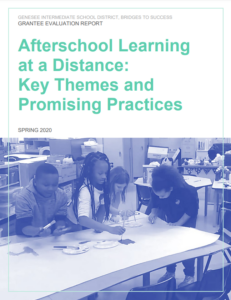
This report describes the experiences and practices of Genesee Intermediate School District: Bridges to Success (GISD) Team Leads and direct staff serving children and families after substantially redesigning afterschool programming due to the COVID-19 crisis.
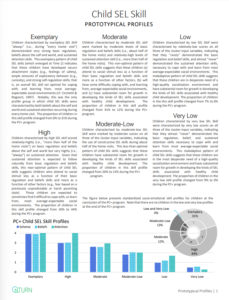
This two-page information sheet explains youth profiles for SEL skills (low, moderate, and exemplary) as they relate to schemas, beliefs, and attention. Created as a supplement to QTurn’s impact report for the Newark Trust for Education Project (NTE) Parent Child Plus (PC+) program, this overview explains how various measurements are tied to key outcomes.

A program quality assessment for 21st Century Community Learning Centers (21st CCLC) and other community-based programs that transitioned virtual, socially distanced in-person, and blended service models. This manual includes: Tool Introduction, Protocol, Standards and Indicators, FAQ, Promising Practices, Method for Development, and Contributors.
The Quality-Impact-Equity Design and Methods (QDM) Toolbox was used to: (a) reconfigure existing measures for Parenting Practice Quality and Child SEL Skill to maximize reliability and validity for measuring socio-emotional skills and learning (SEL); (b) produce holistic profiles of parent and child skill at each timepoint; and (c) apply pattern-centered analytics to estimate impact and equity effects of the PC+
program as implemented in Newark.
This Executive Summary was developed to facilitate discussion and decision making. The detailed findings and method are available in the full report, Impact Evaluation for the Parent Child Plus Program, Newark Trust for Education (2020).
The Management Practices Self-Assessment (MPSA) is a measurement instrument created to empower Michigan 21st CCLC Project Directors, who manage at least one program site. The MPSA provides Project Directors with the opportunity to check-in with themselves and their team by identifying practices and policies that are well-documented and working well, or that could be updated or improved, and areas where they need additional assistance to reach their full potential.
The Management Practices Self-Assessment (MPSA) is a measurement instrument created to empower Michigan 21st CCLC Project Directors, who manage at least one program site. The MPSA provides Project Directors with the opportunity to check-in with themselves and their team by identifying practices and policies that are well-documented and working well, or that could be updated or improved, and areas where they need additional assistance to reach their full potential.
We present steps to (a) identify the real objects we seek to represent with measurement and models (i.e., the parts of an individual’s SEL skill set and the type and amount of skill change that is likely to occur during the program) and (b) produce SEL skill indicators and measures that are feasible and valid for both CQI and impact evaluation uses.
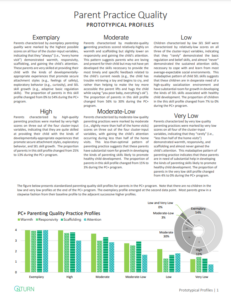
A two-page overview explaining our parent practice measures featured in the client report for Newark Trust for Education.
The Quality-Outcomes Design and Methods (Q-ODM) toolbox holds an integrated set of tools to measure and model children’s SEL skills, including how they change during, and in response to, OST programs (e.g., afterschool, school-age child care, workforce and career preparation, arts, sports).