
Found 46 Results
Page 1 of 5

Page 1 of 5
Page 1 of 5
Original Validation of the Youth Program Quality Assessment (Youth PQA)
January 1, 2005
The original validation study for the Youth Program Quality Assessment (Youth PQA). The Youth PQA was developed to assess the quality of instruction in afterschool and other education settings.
Tags: assessment, methodology, observation, PQA, quality, reliability, validation
January 1, 2005
Youth Program Quality Self-Assessment Pilot Study
January 1, 2005
Overall 24 sites within 17 grantees participated in the self-assessment pilot study by assembling staff teams to collect data and score the Youth Program Quality Assessment (PQA). Youth PQA data collected using the self-assessment method demonstrated promising patterns of both internal consistency and concurrent validity with aligned youth survey responses.
Tags: agile analytics, PQA, Self-Assessment
February 7, 2024
Youth Voice for Climate Readiness in Schools
October 13, 2023
Content and materials from the session Youth Voice for Climate Readiness in Schools, on October 13th, 2023 at the Michigan Afterschool Collaborative – Leadership Summit.
Tags: climate, youth voice
October 13, 2023
Measuring Socio-Emotional Skill, Impact, and Equity Outcomes
August 2, 2021
We present steps to (a) identify the real objects we seek to represent with measurement and models (i.e., the parts of an individual’s SEL skill set and the type and amount of skill change that is likely to occur during the program) and (b) produce SEL skill indicators and measures that are feasible and valid for both CQI and impact evaluation uses.
Tags: Q-ODM Toolbox, SEL
May 16, 2024
Realist(ic) Evaluation Tools for OST Programs: The Quality-Outcomes Design and Methods Toolbox
July 13, 2021
The Quality-Outcomes Design and Methods (Q-ODM) toolbox holds an integrated set of tools to measure and model children’s SEL skills, including how they change during, and in response to, OST programs (e.g., afterschool, school-age child care, workforce and career preparation, arts, sports).
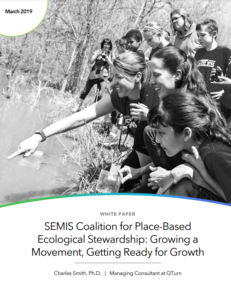
Place-Based Ecological Stewardship
March 1, 2019
This white paper was developed to (1) describe how SEMIS promotes social and emotional learning, (2) iterate content and language with SEMIS stakeholders, (3) and to make a compelling and scientifically grounded case for expansion of the work.
Tags: ecological stewardship, ecology, SEL, SEMIS, STEM
Socio-Emotional Skills, Quality, and Equity: The Multilevel Person-in-Context ~neuroperson (MPCn) Framework
July 13, 2021
We introduce a theoretical framework designed to describe the integrated set of mental and behavioral parts and processes (i.e., schemas, beliefs, and awareness) that are socio-emotional skills and that produce both basic and advanced forms of agency. With improved definitions and understanding of SEL skills, and the causes of SEL skill growth, we hope to improve reasoning about programs and policies for socio-emotional supports in any setting where children spend time.
Tags: assessment, beliefs, continuous quality improvement, Framework, measurement, schemas, SEL
Impact Evaluation for the Palm Beach County Quality Improvement System
July 1, 2019
We sought to answer two specific questions about implementation and children’s SEL skill growth: What is the impact of QIS exposure on program quality (i.e., best practices, low staff turnover, great content), particularly for programs that have lower program quality at baseline? What is the impact of exposure to high program quality on student SEL skills?
Tags: agile analytics, high quality, pattern-centered analysis, quality improvement, youth outcomes
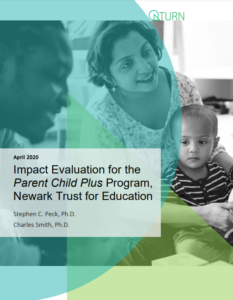
Impact Evaluation for the Parent Child Plus Program
April 1, 2020
The Quality-Impact-Equity Design and Methods (QDM) Toolbox was used to: (a) reconfigure existing measures for Parenting Practice Quality and Child SEL Skill to maximize reliability and validity for measuring socio-emotional skills and learning (SEL); (b) produce holistic profiles of parent and child skill at each timepoint; and (c) apply pattern-centered analytics to estimate impact and equity effects of the PC+
program as implemented in Newark.
Tags: agile analytics, Q-ODM Toolbox, SEL, youth outcomes
Impact Evaluation for the Parent Child Plus Program
April 1, 2020
This Executive Summary was developed to facilitate discussion and decision making. The detailed findings and method are available in the full report, Impact Evaluation for the Parent Child Plus Program, Newark Trust for Education (2020).